With the continued expansion of the food industry and growing consumer interest in healthy fats, nut processing is experiencing significant growth. If you are considering entering this market, a crucial decision must be made: opt for a automatic nut roasting line or a batch nut roasting machine? This choice will directly impact your future development. To help you make an informed decision, here is a detailed comparison.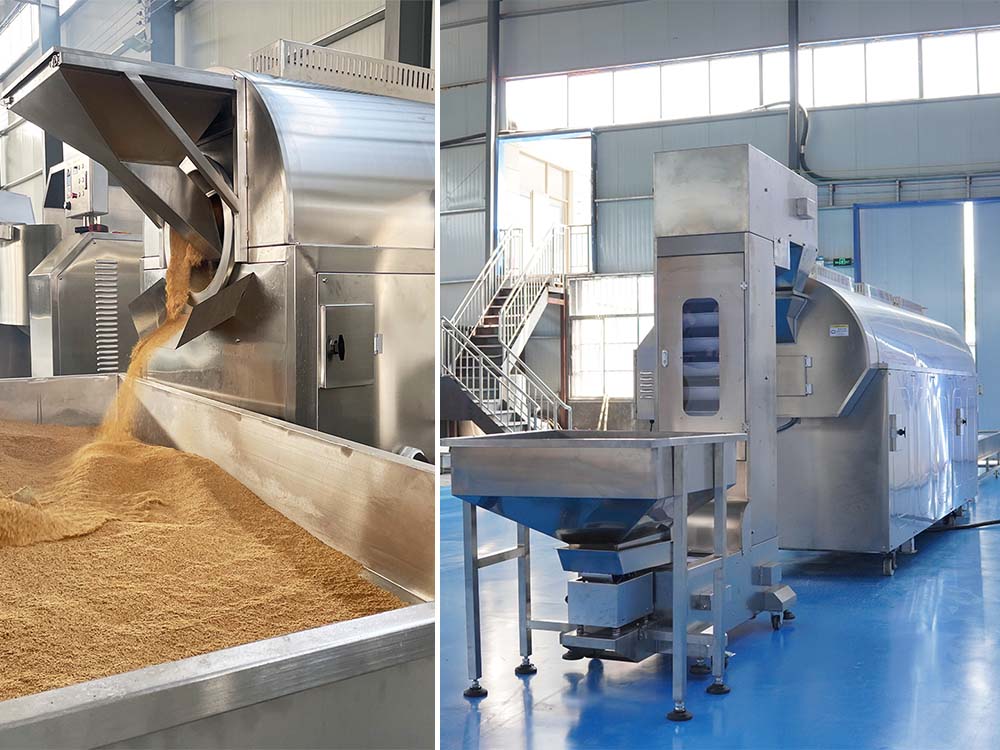
I.Detailed Comparative Analysis
1. Application Scenarios
Nut roasting lines are suitable for supermarkets and retail outlets. OEM manufacturing ensures a stable supply for export. Batch nut roasting machines are suitable for small-batch production and a wide variety of products, and are well-suited to local markets, e-commerce, snack shops, or product development.
2. Equipment Composition
A nut roasting line includes: a feed elevator → a roaster → a cooling line. No manual intervention is required, ensuring a high degree of automation. Batch nut roasting machine consist of a single roasting machine. Manual intervention is necessary between production stages, which limits automation.
3. Capacity
Nut roasting lines have a capacity of 100 kg to 750 kg or more per hour, offering relatively high throughput. Batch nut roasting machine have a production of 30 kg to 500 kg per hour. The throughput is relatively low.
4.From the perspective of product advantages and disadvantages
① Advantages of a nut roasting production line:
② Disadvantages of a nut roasting production line
③ Advantages of batch nut roasting machines
④ Disadvantages of batch nut roasting machines
II.Selection Criteria
1. Situations best suited to a production line
① Large and stable orders with daily demand exceeding 5-8 tons.
② Sought standardization and branding: Perfectly consistent taste and color are essential for each batch of products to build a mid- to high-end brand.
③ Medium- and long-term plans: The company aims to become a major supplier in the region or product category within 3 to 5 years, provided it has sufficient space and funding.
④ High labor costs: The company wants to reduce its reliance on manual labor through automation.
2. Situations better suited to autonomous machines
① Start-up or trial phase: Limited funds, still uncertain market demand, beginning of a small-scale verification phase.
② Multiple product types and batches and each batch produced in small quantities.
③ Local or online retail, which requires significant real-time flexibility.

