Categories
Why Salt-Separating Roaster Is the Best Machine for Sunflower Seed Roasting?
Jun 30th,2026
150 Views
Sunflower seed roasting is different from roasting peanuts, almonds, and other nuts. Sunflower seeds feature thin hulls, high oil content, and delicate surfaces. Traditional roasters that discharge salt together with seeds often cause broken hulls, uneven coloring, excessive salt residue, high material waste, and extra labor costs. For commercial snack factories and bulk seed processing plants, a salt-separating roaster (salt circulating roaster) has become the optimal solution for sunflower seed production. This article explains why the salt-separating roaster is specially designed for high-quality sunflower seed roasting and how it solves the pain points of traditional roasting equipment.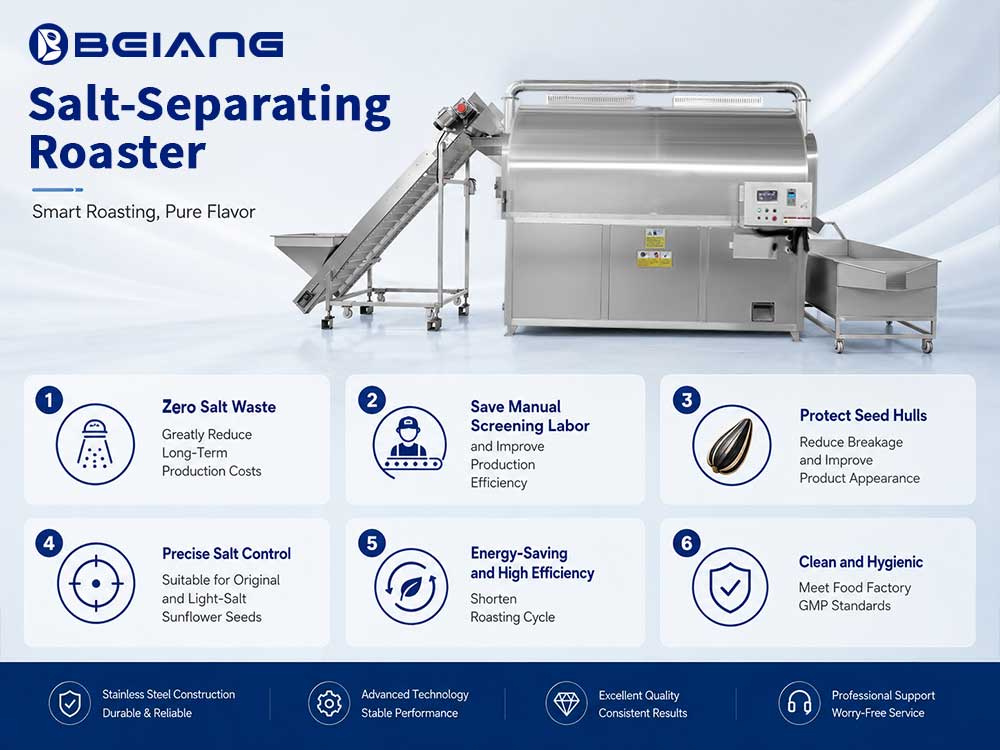 1. The Core Principle: Why Sunflower Seed Roasting Needs Salt MediumProfessional commercial sunflower seed roasting cannot rely on simple dry roasting. Sunflower seeds have small gaps and high oil content. Direct dry roasting leads to concentrated local heat, causing partial burning, black spots, and ununiform ripening.Granular salt acts as a professional heat conduction medium. It fills the gaps between sunflower seeds and wraps every single seed for 360° uniform heating. This technology ensures consistent roasting color, crisp texture, and avoids burnt or raw seeds. However, traditional roasters discharge seeds and salt together after roasting, bringing a series of production problems that greatly restrict sunflower seed product quality and factory profits.2. 6 Key Advantages of Salt-Separating Roaster for Sunflower Seed Processing2.1 Zero Salt Waste, Greatly Reduce Long-Term Production CostsTraditional salt roasters discharge all salt along with sunflower seeds after each batch. A large amount of salt is lost during manual screening and wind selection, requiring continuous salt replenishment, which forms a long-term recurring cost for factories.The salt-separating roasting machine adopts an internal circulating salt separation structure. After roasting is completed, the drum reverses to discharge pure sunflower seeds, while the salt is filtered and retained in the drum for repeated cycling use. The salt loss rate is almost zero, saving a large amount of raw material cost for long-term mass sunflower seed production.2.2 Save Manual Screening Labor and Improve Production EfficiencySunflower seeds are small and mixed with fine salt particles after traditional roasting. Factories must arrange special workers for secondary screening and wind separation, which is time-consuming, labor-intensive, and easily causes production delays during peak seasons.The automatic salt-separating design of the circulating salt roaster realizes one-step finished discharge with no mixed salt. No manual sorting is required, effectively reducing labor dependence. One worker can manage multiple devices at the same time, perfectly matching assembly-line continuous production and greatly improving overall factory output.2.3 Protect Seed Hulls, Reduce Breakage and Improve Product AppearanceSunflower seed hulls are thin and fragile. In traditional processing, repeated pouring, screening, and salt friction will cause a large number of broken seeds, hull peeling, and surface scratches, reducing product grade and market selling price.The circulating salt roasting mode of the no salt discharge roaster keeps the salt stable inside the drum during the whole process. There is no violent friction during discharging. The roasted sunflower seeds have complete hulls, uniform golden color, no black spots or scratches, with a high-grade and clean appearance, more in line with high-end snack market standards.2.4 Precise Salt Control, Suitable for Original and Light-Salt Sunflower SeedsModern consumers prefer healthy low-salt and original-flavor sunflower seeds. Traditional roasters leave a large amount of residual salt on the seed surface after roasting, resulting in overly salty taste that covers the natural nutty flavor of sunflower seeds, making it impossible to produce standard original-flavor products.The salt-separating roaster only uses salt for heat conduction, with no excess salt residue on the finished seed surface. Factories can flexibly adjust subsequent seasoning processes to produce pure original flavor, light salt, and multi-flavor sunflower seeds, covering more market demands and improving product competitiveness.2.5 Energy-Saving and High Efficiency, Shorten Roasting CycleTraditional roasters discharge high-temperature salt together with seeds after each batch, resulting in massive heat loss. The new batch needs to reheat cold salt, which consumes more electricity or gas and prolongs production time.The no salt discharge roaster retains high-temperature circulating salt inside the drum, making full use of residual heat. The thermal efficiency reaches more than 95%, which saves 40%-50% energy compared with traditional equipment. The preheating speed is faster, the roasting cycle is shorter, and it is more suitable for long-term uninterrupted large-batch sunflower seed processing.2.6 Clean and Hygienic, Meet Food Factory GMP StandardsTraditional salt discharging and manual screening will produce a lot of salt dust and seed debris, causing workshop dust pollution, difficult cleaning, and easy breeding of bacteria, failing to meet food safety inspection standards.The fully closed circulating structure of the salt-separating roaster avoids salt scattering and dust overflow. The whole machine is made of food-grade 304 stainless steel, with a clean production environment, which fully meets food processing GMP certification and export factory inspection requirements, helping enterprises smoothly pass customer audits.
3. Traditional Salt-Discharging Roaster vs auto salt-separating Roaster - Salt Consumption: Traditional machine has severe salt loss and recurring material costs; Salt-separating roasting machine realizes salt recycling with zero waste- Labor Cost: Traditional machine requires manual salt screening; Salt-separating roasting machine needs no secondary processing, saving labor- Seed Quality: Traditional machine causes many broken seeds and residual salt; Salt-separating roasting machine ensures complete hulls and clean surface- Energy Consumption: Traditional machine has serious heat loss and high energy consumption; Salt-separating roasting machine makes full use of residual heat, energy-saving and efficient- Applicable Products: Traditional machine is only suitable for heavy-salt sunflower seeds; Salt-separating roasting machine supports original, light-salt and multi-flavor products4. Who Needs a Automatic Salt-Separating Sunflower Seed Roaster?This salt-circulating roasting machine is the best choice for medium and large snack factories, food processing enterprises, and sunflower seed wholesale manufacturers. It is especially suitable for users who pursue stable product quality, low production cost, high automation, and compliant food safety. Whether for small-batch fine processing or large-scale assembly line mass production, it can bring stable profit growth for processing enterprises.Sunflower seed roasting focuses on uniform heating, complete appearance, controllable salt taste, and low production loss. Traditional salt-discharging roasters can no longer adapt to the upgraded and standardized sunflower seed processing industry. The salt-circulating roasting machine solves the core pain points of salt waste, labor waste, high breakage rate, and poor taste control through automatic salt circulation and separation technology. It is the most cost-effective and professional special equipment for modern commercial sunflower seed roasting.

